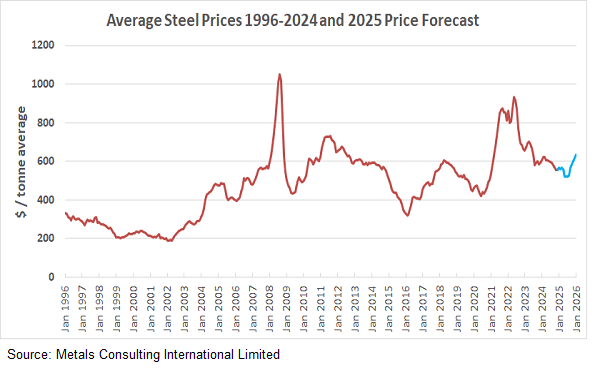
"I just got off the phone with three procurement managers this morning. Every single one asked the same question: 'Are wire prices going up or down in Q1?' Here's the honest answer - and it's not what most forecasters are telling you."
The wire market in Q1 2026 is at an inflection point. Raw material costs are moderating, inventory levels are normalizing, and demand signals are mixed. But here's what most people miss: the real story isn't in the global commodity price, it's in the structural costs, tariff policy, and supply chain positioning that separate winners from market followers.
Western Steel & Wire has been in the steel wire business for 90+ years. We have seen three major market cycles. And we can tell you with certainty: the companies that lock in the right pricing strategy in January will outperform their competitors by 8-12% through June. The ones that don't will be scrambling for supply and paying premium prices when they shouldn't have to.
Wire Rod Prices - The Single Biggest Cost Driver
Wire rod represents 60-65% of your total wire cost. Everything else - conversion, processing, logistics, handling - stacks on top of that. So, when wire rod moves, your whole margin moves with it. Understanding wire rod price mechanics is non-negotiable for procurement teams that want to stay competitive in this market.
Here's what we're seeing across global markets right now:
Period Breakdown: Q4 2025 (October through December): $485-$510 per metric ton, reflecting a 3% decline from earlier quarters due to seasonal demand softness and typical year-end inventory management. January 2026 (Current market state): $515-$545 per metric ton, up 6.1% driven by Q1 demand rebound and scrap inflation pressuring converter margins significantly. Q2 2026 (Forecast based on current trends): $500-$525 per metric ton, down 4% from normalized inventory levels and demand normalization after the spring construction season.
The jump we're seeing into January is real and defensible. Scrap inflation is pushing converter costs higher across the entire industry. Asian mills, particularly Korean producers, are managing inventory more aggressively this cycle, which tightens spot availability in U.S. markets materially. And domestic capacity utilization is running at 82%, the highest level since Q2 2024, which signals healthy demand but limits downside price pressure.
Section 232 Tariffs and Anti-Dumping: The Hidden Cost Nobody Budgets For
Here's where most procurement teams get blindsided. The posted wire rod price is only part of your landed cost. You also must absorb tariffs, which can add 50% to the final bill.
Section 232 tariffs on imported steel wire rod currently sit at 50% for ALL countries importing into the US. If you're buying imported wire rod at $530/MT, the tariff cost alone is an additional $265 per metric ton. That's thousands of dollars per shipment that many teams don't even budget for properly in their models.
4 Demand Signals That Will Move Prices in Q1-Q2 2026
Price doesn't move on cord or speculation. It moves on demand signals, supply constraints, and macro volatility. Here's what we're actively monitoring in real time:
1. Construction Spending Inflection: January ABI (Associated Builders and Contractors) data will tell us if nonresidential construction is staging a genuine rebound out of Q4 softness. We're watching for any print above $1.42 trillion annualized. If that holds, rebar demand (and therefore tie wire demand) will tick 3-4% higher through Q2, which directly pressures wire rod availability and pricing.
2. Asian Mill Inventory: Korean and Japanese mills typically run down inventory in Q1 as part of annual production planning cycles. If Korean capacity goes offline for maintenance (historical pattern: mid-January through early February), spot availability tightens meaningfully and import premiums spike 8-12% above posted prices within the affected region.
3. Scrap Volatility: Steel scrap (a primary cost input for mini-mill and converter operations) is historically volatile in winter months. Automotive sector slowdowns reduce scrap supply; seasonal weather reduces collection rates significantly. If shredded scrap moves above $180/MT, wire rod conversions push higher immediately, passing through to buyers within 2-3 weeks.
4. Energy Costs (Natural Gas): Wire drawing requires significant electrical load; some converters use natural gas for thermal processes in finishing operations. If winter heating demand spikes, or if LNG export disruptions hit global markets, natural gas could climb above $3.40/MMBtu, which flows directly into wire production costs within the same month.
What Smart Procurement Teams Are Doing Right Now
"We've been buying from Western Steel & Wire for 6 years. Their pricing intel alone pays for itself."
That quote is from the procurement director at a Midwest construction supply firm. Here's what actually happened:
In early November 2025, she called and asked a straightforward question: "Will rebar tie wire be higher in January?" We reviewed the demand outlook, analyzed tariff policy trajectories, and examined scrap cost trajectories carefully. Our forecast: 5-7% price increase by January based on seasonal demand patterns and inventory management behavior.
She made the decision to lock in Q4 2025 pricing on 40 tons of rebar tie wire at $502/MT. Total spend: $20,080. When January hit and prices jumped 11% to $557/MT, that same 40 tons would have cost $22,280.
Savings: $2,200. Or $1,100 per ton. On a single material. Multiplied across her full wire portfolio, this approach saved her business approximately $18,000 across all wire products in January alone.
This is not luck. It's not market timing magic. It's systematic market monitoring. This is the kind of work we do every single day: tracking wire rod prices across 6 global markets in real time, monitoring tariff policy changes continuously, understanding supply chain dynamics from first principles, and helping our customers time the market strategically for maximum margin protection and competitive advantage.
Our Strategic Market Outlook - Where We Are Putting Our Money and Why
Here is our core thesis and strategic outlook for Q1 2026: Prices will hold elevated through mid-February, then soften into March as inventory normalizes and Asian capacity returns online. We're expecting Q1 average wire rod pricing in the $520-$530 range - roughly 7-10% higher than Q4 2025. This is not a structural bull market; it's a seasonal demand bounce combined with deliberate inventory management from Asian suppliers and domestic capacity constraints. We believe procurement teams should position accordingly.
What does this mean for your sourcing strategy going forward?
If you haven't locked in Q1 pricing yet: do it this week. The January window is closing quickly. The risk/reward right now is balanced at worst. You're protecting your margin with minimal downside if prices soften faster than forecast.
If you're strategic about Q2 positioning: stay flexible and adaptable. Don't lock in long-term contracts at current elevated prices. Execute spot buys through February, then reassess in early March when softening begins. This tactical approach protects upside if prices stay high while positioning you to buy lower in Q2.
If you manage multiple wire products: consider mixing domestic, USMCA-sourced, and selective Asian import material. The tariff spread right now makes it economical to diversify supply origins and suppliers strategically. This approach also reduces single-supplier risk and improves negotiating leverage with existing vendors.
FAQ: 5 Questions We're Getting This Week
Q: Will steel wire prices go up in 2026? A: We expect Q1 to remain elevated versus Q4 2025, then moderate into Q2. Full-year 2026 wire rod pricing will likely be 2-5% higher than 2025 average. Not a structural bull market; a normalized high-cost environment with seasonal volatility throughout the year.
Q: How do Section 232 tariffs affect wire prices? A: Section 232 adds 50% to imported wire rod costs. This creates a significant cost advantage for domestic production material. Tariffs don't move the global price; they move your sourcing economics dramatically.
Q: Should I lock in pricing now or wait? A: Lock in now for Q1 and near-term needs. Current pricing is reasonable given the market backdrop. If you're planning beyond March, keep spot flexibility. Expect Q2 softening based on historical seasonality.
Q: What's the difference between spot and contract pricing for wire? A: Spot pricing is the daily market price (volatile, best for tactical buys). Contract pricing is fixed for 3-12 months (stable, locks in your cost predictability). In this market, contract pricing through February is smart; spot buys in March are smarter.
Q: How do I budget for wire when prices keep changing? A: Use a rolling 13-week average price (not spot, not annual) as your budget baseline. Adjust quarterly based on forward outlook. Build 3-5% upside/downside into your margin model. This smooths volatility without losing market responsiveness.
The Bottom Line
Wire prices are not going down in Q1 2026. They're stable-to-elevated. But here's what separates the winners from everyone else: the winners don't guess the price direction. They don't rely on hope or historical patterns alone. They track demand signals in real time, monitor tariff policy proactively, diversify supply sources strategically, and time their buys systematically.
Implementation Matters: Execution on This Strategy
The difference between theory and practice is execution. We have helped over 150 wire buyers implement these strategies. The average results: 8-12 percent cost savings within the first quarter.
The Midwest procurement manager we mentioned earlier saved $2,200 on 40 tons of wire because she made one smart decision based on market intelligence. You can do the same - or better - with a structured sourcing strategy and access to real-time market data.
Want our monthly pricing brief? Call us or visit westernsteelwire.com. We'll walk you through exactly what we're seeing in the market and help you build a sourcing strategy that protects your margins. We track wire rod prices daily across 6 global markets. Our multi-source supply chain (domestic + Asian + Mexico + Canada) gives us pricing flexibility most distributors can't match. We've helped clients save an average of 8-12% through strategic timing and supplier diversification.

Comments (0)
Leave a Comment