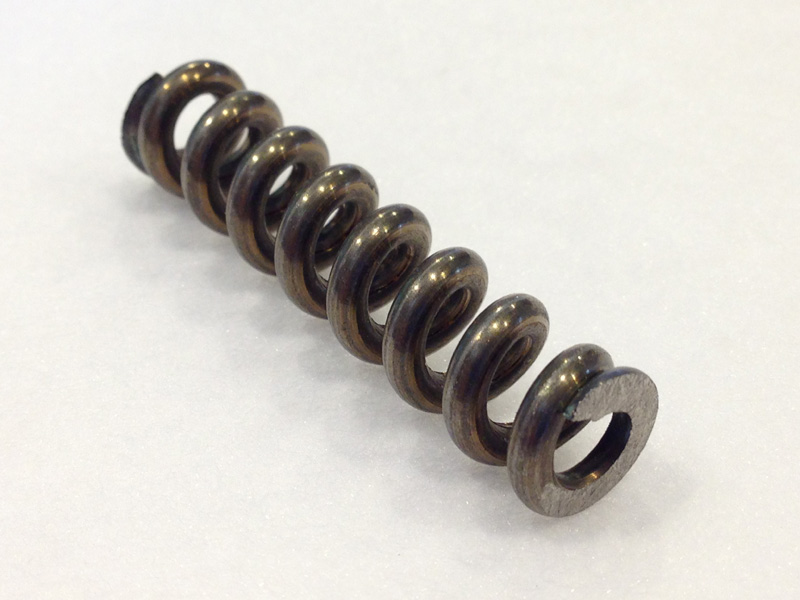
An automotive parts manufacturer in Detroit spec'd standard carbon steel wire for valve springs. Six months and 340,000 warranty claims later, the root cause was crystal clear: they'd chosen the wrong wire. The springs were failing at 2.1 million cycles instead of the required 10 million. The recall cost $8.7 million. The wire upgrade that would have prevented the entire crisis? $0.04 more per pound.
That's not a made-up story. That's an industry story that happens when engineers get spring wire spec wrong. It's happened before. It will happen again. Unless you understand what separates a spring wire that merely holds together from a spring wire that performs under extreme stress for millions and millions of cycles.
Oil tempered wire—specifically ASTM A229—exists for exactly one reason: to give your springs fatigue life that ordinary wire can't touch. When your application demands 10+ million cycle reliability, you don't guess. You spec oil tempered wire, and you sleep at night.
What Makes Oil Tempered Wire Different — The Metallurgy That Matters
Oil tempered wire isn't just "regular wire that's been heated." The process is engineered, controlled, and transformative at the material level.
Here's what happens during oil tempering:
- The wire is drawn to precise diameter with controlled spring temper (hardness)
- The coiled wire is heated to 400–550°F (200–290°C) in a controlled oil bath
- Stress relief occurs—residual manufacturing stresses relax without softening the wire
- The result is wire with superior fatigue resistance and dramatically extended cycle life
Why does this matter? Because untempered spring wire accumulates stress with each cycle. Oil tempering erases those accumulated micro-stresses before they become cracks. Springs live longer. Way longer.
The tensile strength stays high (we're talking 180,000 to 220,000 psi depending on gauge), but the material becomes less brittle. Less prone to fatigue failure. More forgiving. More dependable. It's a material science solution to a mechanical engineering problem: stress accumulation.
ASTM A229 vs. A227 vs. A228: Picking the Right Spec
The ASTM standards for spring wire aren't decorative. Each one covers a specific performance tier and use case. Get it wrong, and you're building a reliability problem that might not show up until you're in the field with hundreds of thousands of units in customer hands.
| Standard | Carbon Content | Tensile Strength | Fatigue Life | Best For | Relative Cost |
|---|---|---|---|---|---|
| ASTM A227 | 0.65–0.75% | 150–170 ksi | 2–3M cycles | Light springs, general industrial | 1.0x |
| ASTM A228 | 0.80–0.95% | 170–190 ksi | 3–5M cycles | Medium duty springs, machinery | 1.2x |
| ASTM A229 (Oil Tempered) | 0.80–0.95% | 180–220 ksi | 8–15M+ cycles | Automotive, high-reliability springs | 1.5x–1.8x |
The decision is really about cycle life and risk tolerance. If you're building light-duty springs in a stable application with predictable loads, A227 can work fine. If you're in automotive—where millions of cycles means the difference between a product success and a recall nightmare—you're reaching for A229. Yes, you'll pay 50–80% more per pound. But that cost vanishes the first time you avoid a warranty claim or prevent a safety issue.
Automotive Applications — Where Oil Tempered Wire Earns Its Keep
Automotive is where oil tempered wire lives. It's the application that defined the standard and continues to push the boundaries of what's possible.
Think about what a valve spring endures: It cycles 3,000 times per minute on a 6,000 rpm engine. That's 180,000 cycles per minute. Over a 200,000 mile engine life, a valve spring goes through 540 billion cycles. Not a typo. Half a trillion cycles per spring, every single engine.
The moment that spring fails, you get a dropped valve, a destroyed piston, and an $8,000+ engine rebuild. Multiply that across thousands of warranty claims, and you're looking at crippling losses. The OEM's warranty exposure is enormous. The driver's safety risk is very real.
This is why Tier 1 and Tier 2 automotive suppliers don't compromise on spring wire. They spec ASTM A229 oil tempered wire because the material science is locked in and proven. It performs. It's predictable. It's proven through billions of cycles in the field across millions of vehicles.
Oil tempered wire handles:
- Valve springs (intake and exhaust)
- Suspension springs (coil and leaf)
- Clutch and brake springs
- Transmission components and shift springs
- Seat belt pretensioners and safety components
In every case, the wire is under repeating stress from the moment the vehicle leaves the factory floor. The stakes are high. The margin for error is essentially zero. Oil tempered wire is the answer that ensures reliability at scale.
The Real Cost of Choosing the Wrong Wire
A Midwest automotive Tier 2 supplier was building suspension springs for a major OEM contract. They had aggressive volume targets and significant margin pressure. On the recommendation of a cost-focused procurement manager, they switched from ASTM A229 oil tempered wire to a generic spring wire blend at $0.28 per pound instead of $0.46.
The cost savings looked great on the spreadsheet: $18,000 annually on raw material for a 50,000-unit annual run. Easy win, right? Wrong.
Six months into production, field failure data started arriving. Springs were fatiguing at 3.2 million cycles instead of the spec'd 12+ million. Warranty claims climbed. Then they accelerated. By month eight, the supplier faced 94,000 warranty returns, massive reverse logistics costs, rush replacement units, and severe OEM penalties for delivery failures.
Total cost of the failure: $2.3 million. Net impact: A $2.282 million loss on what was supposed to be a profitable contract.
"We were spending more on warranty returns than we would have spent on better wire for the next decade," the plant manager told us. "It's a lesson you learn once, then you never forget. We now spec ASTM A229 as a standard requirement. End of discussion. No exceptions."
They switched back to oil tempered wire and fatigue life returned to spec. Warranty claims dropped 94% within the next production cycle. They kept the contract and rebuilt their reputation with the OEM. More importantly, they never made that mistake again.
Heat Treatment, Surface Finish, and What to Specify
When you're ordering oil tempered wire, the fun part is getting specific about exactly what you need. Be precise. Don't be vague. Ambiguity causes problems.
Here's what you need to spec:
Wire Gauge: Oil tempered wire is available from .020" to .500" depending on your application. Smaller gauges are used for precision springs and delicate applications. Larger gauges handle suspension and structural work. Western Steel and Wire stocks .250 to .500, and we can source non-stock sizes on short lead times.
Tensile Strength Class: ASTM A229 has tensile ranges of 180–220 ksi. Higher tension means higher load capacity but sometimes reduced ductility and formability. Your application and forming process determine which end of the range you need.
Format: You can order oil tempered wire in coils or in straighten lengths. Coil condition affects handling, storage, and forming tooling. Coils can be straightened and cut from 6 inches to 30 ft. Specify what your manufacturing process demands to avoid surprises on the line.
Surface Finish: Oil tempered wire has a natural patina from the oil bath. At Western Steel & Wire, we specify surface conditions that are clean and dry with minimal oil. This provides a cleaner finish for coating adhesion or aesthetic reasons.
Certification & Traceability: For automotive and medical applications, you absolutely need full mill cert with tensile data, composition analysis, and heat lot traceability. Western Steel & Wire can deliver that documentation without delay and keep it in your quality records.
Frequently Asked Questions
What is oil tempered wire used for?
Oil tempered wire is engineered for applications that demand extreme fatigue resistance and repeating cycle reliability. The primary use is automotive springs (valve, suspension, clutch, brake), but it's also found in machinery springs, precision industrial components, medical mandrels and springs and anywhere a spring must survive 10+ million cycles without failure. The oil tempering process relieves internal stresses and extends fatigue life 3–5x compared to untempered spring wire.
What's the difference between ASTM A229 and A228?
ASTM A228 is untempered music wire with tensile strength of 170–190 ksi and typical fatigue life of 3–5 million cycles. ASTM A229 is oil tempered, with higher tensile strength (180–220 ksi) and dramatically extended fatigue life of 8–15+ million cycles. A229 also has superior stress relief properties. A229 is lower cost and suitable for lighter applications than A228. A229 is the choice when failure is not an option.
Can oil tempered wire be used for medical springs?
Oil tempered wire CAN be used in medical applications, but it requires strict biocompatibility verification and surface finish specifications. Medical devices typically require stainless steel wire (316 or higher) with FDA compliance documentation. If you're considering oil tempered wire for a medical application, consult with your supplier on ISO 13485 compliance, surface finish, sterilization compatibility, and biocompatibility testing.
What gauges does oil tempered wire come in?
ASTM A229 oil tempered wire is available in a wide range of gauges. Western Steel & Wire stocks .250" through .500", with most common gauges in immediate inventory. Larger gauges and specialty sizes are available on short lead times. If you have a non-standard requirement, we can source it directly from the mill with reasonable lead time.
How does oil tempering improve fatigue life?
Oil tempering relieves residual stresses that accumulate during wire drawing and coiling processes. These microstresses are invisible under static load, but under repeating stress—like in a spring—they accelerate crack initiation and fatigue failure. The controlled heat treatment in an oil bath relaxes those stresses without softening the wire's strength. The result: cleaner microstructure, reduced stress concentration points, and dramatically improved cycle-life performance. It's metallurgy working for you.
The Bottom Line
Oil tempered wire isn't a premium feature. It's a survival requirement for any spring application where failure is unacceptable. If you're building springs or components that must handle millions of cycles reliably, ASTM A229 oil tempered wire is the only choice that makes sense.
Don't cheap it. Don't guess it. Don't learn this lesson the hard way like the Midwest supplier did.
Whether you're producing valve springs, suspension components, medical mandrels, or precision industrial springs, Western Steel & Wire stocks the oil tempered wire you need. We carry ASTM A229 in gauges from .250" to .500", ready to ship, with full ASTM traceability and mill certification. We can custom straighten and cut any diameter to your length specifications. We'll match your spec sheet to the right wire—no charge for the consultation. Visit westernsteelwire.com or call us. We'll get your springs spec'd right the first time.

Comments (0)
Leave a Comment