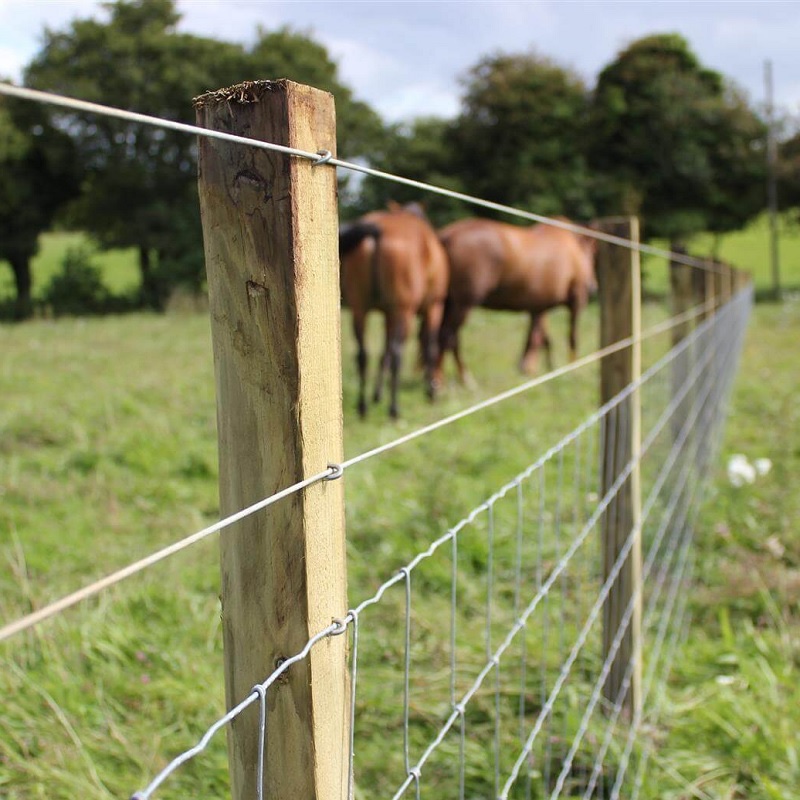
A cattle rancher in the Central Valley lost 14 head of Angus - $42,000 worth of livestock - in a single night because a section of his fence line failed. The wire was 8 years old, but it wasn't supposed to fail for another 20. Turned out his supplier had sold him Class 1 galvanized when his coastal-adjacent property needed Class 3. That $600 savings on wire cost him $42,000 in cattle.
Farmers don't buy wire because they want to - they buy it because they have to. So it better work. Agricultural fencing carries real stakes: livestock safety, crop protection, property security, and your bottom line. Pick the wrong wire, and you're looking at replacement costs, lost animals, crop damage, or worse.
This guide walks you through every fencing wire type, the right gauge for each application, why galvanization matters more than most suppliers admit, and how to calculate the real cost of wire failure. We'll show you the difference between a $600 mistake and a $42,000 one.
Agricultural Fencing Wire Types: Galvanized, High-Tensile, and Barbed
Agricultural fencing isn't one-size-fits-all. The wire you choose depends on what you're containing, what's trying to get in, and how many years you need it to last. Here's the breakdown:
Key Takeaway: Galvanization class directly correlates with lifespan. Skipping one class in a corrosive environment (coastal, high-humidity) can cut wire life in half.Key Takeaway:Galvanization class directly correlates with lifespan. Skipping one class in a corrosive environment (coastal, high-humidity) can cut wire life in half.
Livestock Fencing: Cattle, Horse, Sheep, and Goat Wire Requirements
Not all livestock are created equal, and neither are their fencing requirements. Cattle need containment. Horses need visibility and forgiveness (they trust their eyes). Sheep and goats need security - they'll find any weakness. Here's what each animal demands:
For cattle: #6 (4.1mm) galvanized fencing wire is the industry standard. Ranchers use either Class 2 for inland operations or Class 3 for properties with salt air, higher humidity, or irrigation runoff. Cattle test fences with body weight and persistence - they'll lean on that wire for hours. You need tensile strength (around 1,640 PSI) to hold them. That's why thin wire fails. We've seen ranchers try to save $40 per roll by going to #8 gauge. Then they lose an animal and remember why they shouldn't.For cattle:#6 (4.1mm) galvanized fencing wire is the industry standard. Ranchers use either Class 2 for inland operations or Class 3 for properties with salt air, higher humidity, or irrigation runoff. Cattle test fences with body weight and persistence - they'll lean on that wire for hours. You need tensile strength (around 1,640 PSI) to hold them. That's why thin wire fails. We've seen ranchers try to save $40 per roll by going to #8 gauge. Then they lose an animal and remember why they shouldn't.
For horses: Use #8 (3.3mm) barbed or Class 2/3 smooth wire. Horse fencing has a different philosophy - you're creating a psychological barrier they won't test hard. Barbed wire works well here because horses respect it on sight. Smooth wire requires tighter spacing (wire closer together) because horses run first, think later. Never use vinyl-coated smooth wire for horses - they'll test it with their teeth, and the coating fails in UV sun.For horses:Use #8 (3.3mm) barbed or Class 2/3 smooth wire. Horse fencing has a different philosophy - you're creating a psychological barrier they won't test hard. Barbed wire works well here because horses respect it on sight. Smooth wire requires tighter spacing (wire closer together) because horses run first, think later. Never use vinyl-coated smooth wire for horses - they'll test it with their teeth, and the coating fails in UV sun.
For sheep and goats: Go with #11 (2.7mm) or #12 (2.4mm) barbed wire, Class 2 galvanized. Smaller animals mean smaller wire - but don't skimp on gauge for a thinner look. The smaller diameter is offset by the barbs (which these animals respect) and the fact that they're lighter-weight animals, so tensile strength requirements drop. Class 2 is usually sufficient here unless you're in a coastal zone.For sheep and goats:Go with #11 (2.7mm) or #12 (2.4mm) barbed wire, Class 2 galvanized. Smaller animals mean smaller wire - but don't skimp on gauge for a thinner look. The smaller diameter is offset by the barbs (which these animals respect) and the fact that they're lighter-weight animals, so tensile strength requirements drop. Class 2 is usually sufficient here unless you're in a coastal zone.
Vineyard and Crop Support Wire: Why Trellis Wire Is Different
Vineyard wire is a completely different animal than livestock fencing. You're not containing animals - you're supporting thousands of pounds of fruit, vine weight, and seasonal growth while maintaining hand-harvest accessibility. Napa Valley wineries (and almond and pear growers) understand this better than anyone.
High-tensile galvanized wire is the gold standard here. Look for #8 or #9 (3.2mm) gauge, Class 3 galvanization (because you're looking at 15-20+ year lifespans, and UV + moisture are constant enemies in a vineyard). High-tensile wire has tensile strength between 2,000-2,500 PSI - much stronger than standard fencing wire - so you can use a thinner gauge and save money. A Napa Valley vineyard owner switched from standard galvanized #6 to high-tensile #9 on her 40-acre property. Her previous supplier had quoted her a wire replacement every 5 years. With high-tensile Class 3 from us, she extended that to 15 years. Over that same 15-year span, she saved $23,000 in wire and labor. "I wish I'd known about high-tensile 10 years ago," she told us. "That's $230,000 in wire I didn't need to buy."
For crop support (tomatoes, hops, pole beans), bright basic or black annealed wire works - no galvanization needed because you're replacing it annually or bi-annually anyway. Use #12 or #14 (2.0mm) gauge and pair it with twine for easier harvesting. Cost-per-acre is your main concern here, not longevity.For crop support (tomatoes, hops, pole beans),bright basic or black annealed wire works - no galvanization needed because you're replacing it annually or bi-annually anyway. Use #12 or #14 (2.0mm) gauge and pair it with twine for easier harvesting. Cost-per-acre is your main concern here, not longevity.
Galvanization Classes for Agricultural Wire: Why It Matters in the Field
Galvanization isn't just a surface coating - it's corrosion insurance. The heavier the zinc coating (measured in microns or ounces per square foot), the longer your fence lasts. The ASTM standard defines four classes:
Class 1: Lightest coating (0.20 oz/ft² or ~6 microns). Good for interior, dry climates. Lifespan: 4-8 years. Use this only if money is critical and you're replacing every 5 years anyway.Class 1:Lightest coating (0.20 oz/ft² or ~6 microns). Good for interior, dry climates. Lifespan: 4-8 years. Use this only if money is critical and you're replacing every 5 years anyway.
Class 2: Standard agricultural coating (0.40 oz/ft² or ~12 microns). This is the workhorse for inland farms. Lifespan: 8-12 years. Perfect for cattle in non-coastal zones.Class 2:Standard agricultural coating (0.40 oz/ft² or ~12 microns). This is the workhorse for inland farms. Lifespan: 8-12 years. Perfect for cattle in non-coastal zones.
Class 3: Heavy-duty coating (0.80 oz/ft² or ~24 microns). The premium choice for coastal areas, high-humidity zones, or vineyards. Lifespan: 15-20+ years. This is what that Central Valley rancher should have bought.Class 3:Heavy-duty coating (0.80 oz/ft² or ~24 microns). The premium choice for coastal areas, high-humidity zones, or vineyards. Lifespan: 15-20+ years. This is what that Central Valley rancher should have bought.
Class 4: Extra-heavy coating (1.20 oz/ft² or ~40 microns). Industrial strength, rarely needed for fencing. Reserved for extremely corrosive environments (seaside industrial zones).Class 4:Extra-heavy coating (1.20 oz/ft² or ~40 microns). Industrial strength, rarely needed for fencing. Reserved for extremely corrosive environments (seaside industrial zones).
The real cost of skipping a galvanization class shows up 5-8 years later, not at the time of purchase. That rancher saved $600 on his order. He spent $42,000 replacing his herd.The real cost of skipping a galvanization class shows up 5-8 years later, not at the time of purchase.That rancher saved $600 on his order. He spent $42,000 replacing his herd.
The $42,000 Fence Failure: Lessons From the Field
This isn't hypothetical. A rancher in the Central Valley (near Salinas) had been running Angus cattle for 18 years. His fencing supplier quoted him on a fence line replacement - 2,400 linear feet for his perimeter. The supplier had two options: Class 1 galvanized at $0.42/lb or Class 3 galvanized at $0.48/lb. The difference? $600 on an order size.
He chose the cheaper option. Not because he was price-shopping recklessly, but because his supplier didn't explain the difference. The supplier just quoted the numbers.
Eight years later, the fence failed. A section near the irrigation canal (high moisture, salt spray from sprinkler drift) rusted through. The wire, which was supposed to last 15-20 years in a normal environment, had failed after 8 because Class 1 galvanization simply wasn't designed for coastal-adjacent environments. The breach was discovered at night. Fourteen head of cattle got out and scattered across a neighboring property. The neighbor ran a dairy operation, and the rancher's Angus got mixed with the herd. It took two days to sort them out. Two of his breeding Angus never came back. Twelve more had to be treated for injuries.
At today's feeder cattle prices, 14 head of Angus runs $42,000 to $50,000. The fence repair cost $3,200. The vet bills and recovery time cost another $8,000. A $600 savings turned into $53,200 in losses. "If my supplier had just explained what Class 1 meant in my environment," he told us afterward, "I'd have paid the extra six hundred without thinking twice."
FAQ: Agricultural Fencing Wire
What gauge wire is best for cattle fencing?
#6 (4.1mm) is the industry standard. Cattle test fences with sustained body weight and pressure. Thinner gauges (#8, #10) fail prematurely. For heavy breeding stock or large bulls, #5 (4.6mm) may be justified if your property is particularly challenging.
How long does galvanized farm fence really last?
Class 2 in inland climates: 8-12 years. Class 3 in inland climates: 15-20 years. Class 3 in coastal or high-humidity zones: 15-20+ years. Class 1: Skip it for permanent fencing. These timelines assume you don't have extreme chemical exposure (fertilizer runoff, road salt) or physical damage.
What wire is used for vineyard trellising?
High-tensile galvanized wire, #8-9 gauge (3.2mm), Class 3 galvanization. High-tensile means 2,000-2,500 PSI tensile strength - much stronger than standard fencing wire. This allows you to use thinner gauge and fewer support posts while extending wire life to 15-20+ years. Standard galvanized fencing wire won't deliver the longevity you need in a vineyard.
Is high-tensile wire worth the extra cost?
For vineyards, absolutely. Replacing wire every 5 years versus every 15 years - over a 40-acre operation, that's $20,000-30,000 in savings per replacement cycle. For livestock fencing, high-tensile is less critical because you're typically using thicker gauges anyway. Use it if you're trying to minimize posts and span longer distances.
Can I use barbed wire for horse fencing?
Yes, but use smooth wire as a better first choice. Barbed wire works for horses because they respect it visually, but smooth wire allows for tighter spacing (which horses also respect) without the injury risk if they spook and run into it. If you do use barbed, ensure it's Class 2 or Class 3 galvanized and avoid electrical tape - tape fails in rain.
The Bottom Line
Agricultural fencing wire is not a consumable to order blindly. It's a critical infrastructure investment that directly impacts livestock safety, crop productivity, and your farm's profitability. Get the gauge right. Get the galvanization class right. And don't skip classes to save a few hundred dollars upfront - you'll pay thousands in failure costs down the road.Agricultural fencing wire is not a consumable to order blindly. It's a critical infrastructure investment that directly impacts livestock safety, crop productivity, and your farm's profitability. Get the gauge right. Get the galvanization class right.And don't skip classes to save a few hundred dollars upfront - you'll pay thousands in failure costs down the road.
Western Steel & Wire has been supplying agricultural fencing wire to farms and ranches across the western United States since 1932. We stock Class 2 and Class 3 galvanized wire in every gauge you need, plus high-tensile options for vineyards and specialty applications. We source from the best mills in North America - Deacero (Mexico) and Tree Island Steel (Canada) - both USMCA-compliant suppliers with consistent quality and fast turnaround. We can cut and spool wire to your exact specifications, and we offer competitive bulk pricing for fence contractors and large ag operations.Western Steel & Wirehas been supplying agricultural fencing wire to farms and ranches across the western United States since 1932. We stock Class 2 and Class 3 galvanized wire in every gauge you need, plus high-tensile options for vineyards and specialty applications. We source from the best mills in North America - Deacero (Mexico) and Tree Island Steel (Canada) - both USMCA-compliant suppliers with consistent quality and fast turnaround. We can cut and spool wire to your exact specifications, and we offer competitive bulk pricing for fence contractors and large ag operations.
Whether you're fencing cattle, trellising vineyards, or supporting crops, talk to someone who actually knows wire. Visit westernsteelwire.com or call us to discuss your fencing project. We'll help you choose the right wire the first time - so you don't learn the hard way like that Central Valley rancher.Whether you're fencing cattle, trellising vineyards, or supporting crops, talk to someone who actually knows wire. Visitwesternsteelwire.comor call us to discuss your fencing project. We'll help you choose the right wire the first time - so you don't learn the hard way like that Central Valley rancher.
Comments (0)
Leave a Comment