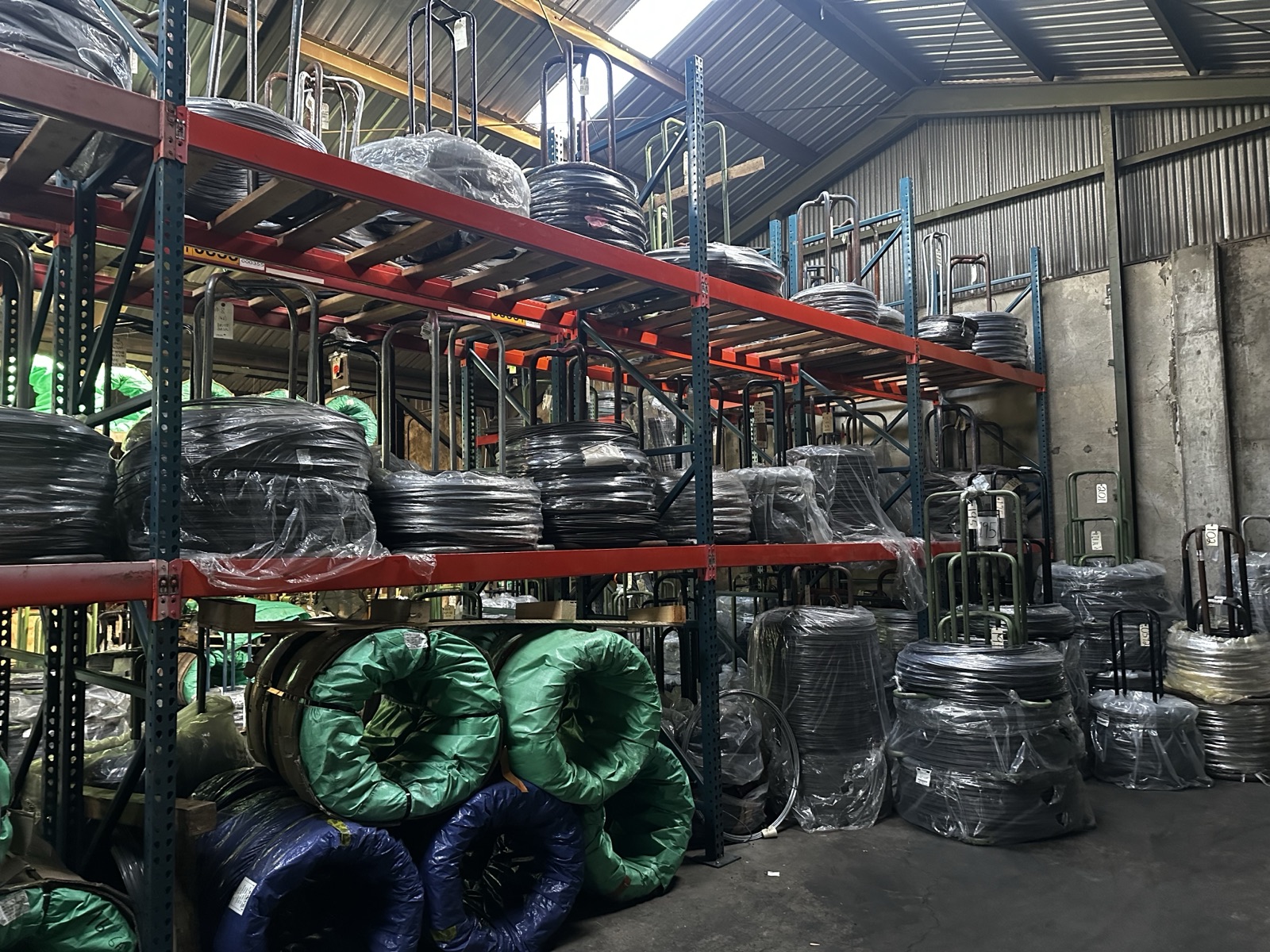
A contract manufacturer in San Jose was sitting on $180,000 of wire inventory at any given time. Carrying costs alone - warehouse space, insurance, capital tied up, oxidation losses - were eating $31,000 a year. And here's the kicker: 22% of that inventory was wire they'd over-ordered on jobs that got canceled or changed spec. They were literally paying $31,000 a year to store wire they might never use.
The wire industry hasn't caught up with lean manufacturing. Most shops still order wire like it's 1995.
The True Cost of Carrying Wire Inventory
Here's what most manufacturers miss: wire inventory costs aren't just about capital. That $180,000 in wire sitting on the shelf is generating costs on seven different vectors, and most companies don't track them separately. You're bleeding money in ways you can't see.
Look at the breakdown below. An inventory value of $100,000 isn't costing you $100,000. It's costing you an additional $24,000 to $41,000 per year just to hold it. That's not a wire problem. That's a business problem.
| Cost Element | % of Inventory | Example ($100K) | Annual Cost |
|---|---|---|---|
| Capital Cost | 8-12% | $8,000-$12,000 | $8,000-$12,000 |
| Warehouse & Rent | 5-8% | $5,000-$8,000 | $5,000-$8,000 |
| Insurance & Risk | 2-4% | $2,000-$4,000 | $2,000-$4,000 |
| Obsolescence | 4-7% | $4,000-$7,000 | $4,000-$7,000 |
| Oxidation & Damage | 3-6% | $3,000-$6,000 | $3,000-$6,000 |
| Handling & Labor | 2-4% | $2,000-$4,000 | $2,000-$4,000 |
| TOTAL | 24-41% | $24,000-$41,000 | $24,000-$41,000 |
Now multiply that across your entire supplier base. If you're carrying wire from three or four different sources, you're looking at $75,000 to $120,000 in annual carrying costs. That money isn't buying you inventory - it's the price of inefficiency.
The San Jose manufacturer we mentioned realized all of this when they finally did the math. That's when they called Western Steel & Wire about a different approach.
The Real-World Impact: One Manufacturer's Transformation
The San Jose contract shop we mentioned produces custom components for aerospace and medical device clients. They were a classic example of how legacy buying patterns destroy margins without anyone realizing it.
Their old model: Place monthly orders for five to six different wire gauges, minimum $22,000 per order. They'd sit on that inventory for weeks, sometimes months, until actual jobs came in. When a customer changed a spec or a project got postponed, that wire became dead inventory. When demand spiked and they ran short, they paid premium rush charges. Meanwhile, their warehouse was bleeding money.
The transformation started with a simple conversation: What if your supplier held the inventory instead of you? What if you only requested delivery when you actually had orders in-house?
Within six months of implementing a blanket PO with Western Steel & Wire, their wire inventory dropped from $180,000 to $45,000. That $135,000 reduction freed up capital they deployed into CNC equipment. Carrying costs dropped from $31,000 annually to just $8,000. And here's the kicker: they eliminated rush charges entirely because they could now pull wire on short notice without penalty.
JIT Wire Supply - How It Actually Works
Just-In-Time isn't magic. It's not even complex. It's just the idea that you get wire when you need it, not six months before. And it only works when your supplier has the inventory and the logistics to deliver.
Here's how the San Jose shop restructured their wire buying:
- Moved from monthly bulk orders (minimum $22,000 per order, six different wire gauges) to a blanket PO against Western Steel & Wire's inventory. They committed to annual volume targets - roughly what they'd historically ordered, but spread across the year.
- Started submitting weekly delivery requests against that blanket PO, tied to their actual production schedule. One week they need 800 lbs of 0.072" black annealed for tie wire, the next week it's 400 lbs of 0.063" galvanized.
- Reduced on-site wire inventory from $180,000 to $45,000 - just enough for two weeks' worth of production at average volumes. Anything above baseline gets delivered on schedule.
- Cut carrying costs from $31,000 per year to $8,000 per year - a 74% reduction. That freed up $23,000 in direct annual savings, plus reclaimed 1,200 square feet of warehouse space.
- The wire never sat in their building long enough to oxidize. Spec changes (which killed their old model) didn't matter - they just changed the next delivery request. Safety stock became a non-issue.
Blanket POs, Scheduled Releases, and VMI - Your Options
JIT isn't one-size-fits-all. Different manufacturers need different models. Here's how to match strategy to your business:
| Strategy | How It Works | Best For |
|---|---|---|
| Blanket PO + Releases | You commit to annual volume, supplier holds inventory, you request delivery on schedule | Predictable demand, stable specs |
| Vendor-Managed Inventory | Supplier monitors your wire levels, automatic restocking against minimums | High-volume, standard products |
| Weekly Releases | You provide rolling 12-week forecast, supplier ships weekly against demand | Variable demand, spec changes |
| Consignment Inventory | Wire sits in your warehouse but supplier owns it until you consume it | High-volume, strong commitments |
The San Jose shop went with blanket PO + scheduled releases because they had variable demand but stable spec requirements. A high-volume spring manufacturer we work with chose VMI because their demand is predictable and their spec never changes. Find the model that matches your operation.
When JIT Makes Sense - and When It Doesn't
JIT is not the answer for every shop. Be honest about your operation before you commit.
JIT Makes Sense When:
- Your demand is relatively stable or predictable - you can forecast 4-8 weeks out with reasonable accuracy.
- Your supplier has deep inventory in your core gauges and alloys - they can ship within 2-4 days consistently.
- Your warehouse rent or carrying costs are significant - $5,000+ per month in storage.
- You have consistent issues with excess or dead inventory - spec changes, canceled jobs, seasonal demand.
JIT Creates Problems When:
- Your demand is unpredictable or spiky - one-off projects, bid-based work, heavy seasonal swings.
- You need specialty wire or custom gauges that require long lead times (12+ weeks for new inventory).
- Your supplier can't commit to consistent 2-4 day delivery windows.
- You're carrying heavy safety stock due to supply chain risk or geographic distance from suppliers.
How Western Steel & Wire Makes JIT Work for Wire Buyers
We hold the inventory so you don't have to. That's not a slogan - it's our business model.
Western Steel & Wire carries the largest bare wire inventory in the western United States - all eight major wire types (bright basic, stainless, music wire, black annealed, oil tempered, galvanized, aluminum, copper) in 100+ gauges and sizes. We stock to depth because it lets our customers stock light.
Our 90+ years in the wire business means we understand the cost pressures you face. We've built our operation around the principle that you should never have to carry inventory you don't need. We do that work. We manage the capital, the storage, the risk of oxidation and obsolescence. You just pull wire when you need it.
Here's what we offer to support JIT programs:
- Blanket PO agreements with committed volume terms and price stability - we lock in unit pricing for 12 months, you lock in total volume. No surprises, no quarterly hikes.
- Scheduled weekly delivery releases - you give us release forecasts, we ship on your schedule. 2-4 day standard delivery on 99%+ of our inventory.
- VMI-ready capabilities - we can set up automatic restocking against your minimum stock thresholds if you want hands-off ordering.
- Spec change flexibility - if your project changes and you need a different gauge or alloy, next release request accommodates it. No minimum order penalties.
- Straight wire + value-add services - we don't just ship wire. We straighten, cut, coil, and spool to your spec. That means one supplier for wire AND finishing, which simplifies your supply chain even more.
Frequently Asked Questions
What is JIT wire supply, exactly?
JIT (Just-In-Time) wire supply is a procurement model where you order and receive wire on a scheduled basis tied to your actual production demand, rather than buying large quantities upfront. Your supplier maintains the inventory; you pull wire as you need it. Lead times are short (2-4 days), and you carry minimal safety stock. The supplier benefits from volume certainty; you benefit from lower carrying costs and better cash flow.
How much does wire inventory actually cost to carry?
Between 24% and 41% of your total inventory value, annually. A $100,000 wire inventory generates $24,000 to $41,000 in annual carrying costs - capital opportunity, warehouse rent, insurance, obsolescence, oxidation, and labor. Multiply that across all your inventory and suppliers, and most manufacturers are shocked at the total.
What's a blanket purchase order for wire?
A blanket PO is a long-term contract (typically 12 months) where you commit to a total volume and unit pricing, but deliveries happen on your schedule. Instead of one large PO, you submit scheduled delivery requests throughout the year. It gives you price certainty and the supplier volume certainty, while keeping your warehouse light.
Can JIT work for specialty wire like stainless or music wire?
Absolutely. Stainless steel and music wire JIT programs are actually ideal because the specs are stable and there's no guessing about what you'll need. Lead times are longer for specialty metals (sometimes 6-8 weeks for new mill runs), but if you're forecasting accurately, that becomes irrelevant. Western Steel & Wire stocks both 304 and 316 stainless, music wire in all tempers, and can support JIT programs on both.
What lead times should I expect with JIT wire delivery?
Standard products from inventory: 2-4 days. Custom sizes or cuts: 5-7 days. Specialty alloys not in stock: 6-12 weeks for mill procurement. The key is planning: give your supplier a rolling 12-week forecast and firm up delivery dates week-by-week. That eliminates surprises and rush charges.
The Bottom Line
Wire inventory is expensive. Most manufacturers are paying 24-41% of their inventory value every single year just to store wire they ordered months ago. That's capital that could be deployed elsewhere, warehouse space that could shrink your footprint, and risk that could disappear.
JIT wire supply isn't theory. It's working right now at contract manufacturers, spring companies, and scaffolding shops across the western United States. The San Jose manufacturer we mentioned dropped carrying costs from $31,000 to $8,000 annually, freed up real estate, and actually improved delivery reliability because they weren't trying to manage six-month forecasts.
If you're ready to rethink how wire flows into your operation, Western Steel & Wire is built for it. We stock the inventory depth so you don't have to. We can set up blanket POs, scheduled releases, or full VMI programs. We deliver within days, flex on spec changes, and offer wire straightening, cutting, and forming services in-house. We're 90+ years into this business, and we understand the nuances of wire supply in a way most competitors never will.
Stop tying up capital in wire you don't need yet. Visit westernsteelwire.com or call us to set up a JIT wire program that actually works for your business.
Comments (0)
Leave a Comment