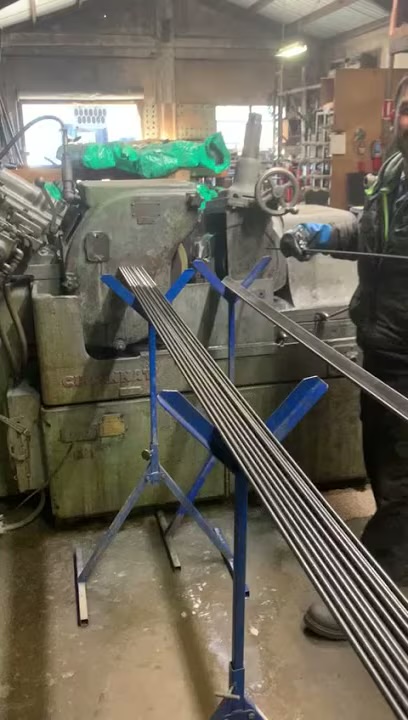
When a guidewire for a cardiac catheter needs to be exactly 0.014 inches in diameter - not 0.0145, not 0.0135 - there's only one process that can deliver that level of precision at production volume:centerless grinding.
A Bay Area medical device company learned this the hard way when their drawn wire varied by ±0.001 inches and their catheters wouldn't track properly through simulated vasculature. Three months of development time, wasted. Engineering costs mounting. QA rejections piling up. The fix? Precision grinding - and suddenly the same wire performed flawlessly. Same material. Different process. The difference was $180,000 in development delays eliminated.
Centerless grinding is where wire becomes a precision component. It's the difference between commodity wire and engineered material. For medical device manufacturers, aerospace engineers, precision instrumentation producers, and electronics assemblers, it's often the only acceptable path to tolerances and surface finishes that raw drawn wire simply cannot achieve. No matter how carefully you draw wire through a die, the laws of material flow limit how tight a tolerance you can hold - and more importantly, how smooth the resulting surface becomes.
Here's what you need to know about centerless grinding, when it's mandatory versus optional, and how Western Steel & Wire delivers ground wire to tolerances tighter than 0.0001 inch.
What Is Centerless Grinding and How Does It Work?
Unlike conventional grinding, which requires a center point (a lathe, spindle, or fixed arbor) to hold the workpiece,centerless grinding uses two rotating wheels - a grinding wheel and a regulating wheel - to grip the wire and feed it through at a precise, controlled rate.
Here's the mechanical elegance of centerless grinding: the grinding wheel (rotating at high speed, typically 5,000-10,000 RPM depending on wire diameter) removes material from the wire surface. The regulating wheel (rotating slower, around 200-800 RPM) controls the feed speed and exerts gentle pressure to maintain contact. The workpiece is supported by a blade or V-rest that keeps it centered between the wheels without any chuck or fixture.
Because there's no spindle, no chuck, no center hole required, the entire circumference of the wire is accessible for grinding - and more importantly, the process is naturally self-centering and incredibly uniform. The wire feeds continuously, grinding from one end to the other. If the wire is 50 feet long, all 50 feet get the same precise treatment.
The result: diameter tolerances of ±0.0002 inch or better, surface finish to Ra 8 microinches or finer, and perfect roundness across the entire length. For comparison, drawn wire typically delivers ±0.001 inch to ±0.002 inch diameter variation and Ra 32 to Ra 64 microinches surface roughness.
At Western Steel & Wire, we've invested in production-scale centerless grinding equipment specifically for wire diameters ranging from 0.010 inches to 0.500 inches, handling everything from delicate medical guidewire stock to robust aerospace fastener shafts. Our equipment is calibrated quarterly and our process parameters are validated against ASTM and ISO standards to ensure consistency across every batch.
Tolerance and Surface Finish Capabilities
This table compares centerless grinding performance across three capability levels - from standard industrial applications to aerospace and medical precision. Our data comes from validated CMM (coordinate measuring machine) measurements and SEM surface analysis across production batches:
| Parameter | Standard Grinding | Precision Grade | Ultra-Precision |
|---|---|---|---|
| Diameter Tolerance | ±0.001" | ±0.0005" | ±0.0002" |
| Surface Finish (Ra) | Ra 16-32 µin | Ra 8-16 µin | Ra 4-8 µin |
| Roundness (TIR) | 0.001-0.002" | 0.0005-0.001" | 0.0001-0.0005" |
| Diameter Range | 0.062" - 0.500" | 0.020" - 0.375" | 0.010" - 0.250" |
| Materials | Steel, stainless, non-ferrous | 316SS, Nitinol, music wire, carbon | All materials including exotic alloys |
| Typical Applications | Springs, fasteners, general mfg | Medical device, aerospace pins | Surgical instruments, guidewires |
Medical Device Wire - Where Grinding Is Non-Negotiable
In the medical device industry, centerless grinding isn't optional - it's a fundamental requirement for product quality and patient safety.Guidewires for cardiovascular catheters, stent delivery systems, and endoscopy instruments demand diameter consistency tighter than ±0.0002 inch.
The physics is unforgiving: the difference between 0.014 inches and 0.0142 inches determines whether a guidewire tracks smoothly through tortuous vessels or binds and causes arterial trauma. Tolerance stack-up across a 3-meter guidewire can easily accumulate to 0.003 inches if your wire source isn't precision-controlled. That small variation translates directly to delivery failure, longer procedure times, and potential patient harm.
The Bay Area medical device company we mentioned above initially sourced 316L stainless drawn wire - the correct alloy for biocompatibility and corrosion resistance. The material was perfect. The diameter was not. Drawing tolerances of ±0.001 inch are acceptable for many applications, but not for a guidewire that must navigate vessels as small as 0.070 inches in diameter and fit inside a catheter lumen with micron-level clearances.
After failing benchtop vasculature simulation tests three times - costing roughly $60,000 per cycle for prototype development and lab testing - they contacted Western Steel & Wire. We ground their 316L wire to ±0.0002 inch diameter tolerance with Ra 4 microinches surface finish. Same material. Different diameter consistency. Their next benchtop test passed on the first attempt. Guidewires tracked smoothly through the simulated vasculature model with zero binding. No rework. No additional cycles.
Total value recovered: $180,000 in development delays plus the value of making their market launch timeline. That's the power of precision grinding for medical applications. For this company, the decision was simple: grind the wire or lose the product launch window.
Beyond Medical: Aerospace, Electronics, and Precision Manufacturing
Medical devices aren't the only industry where ground wire is mission-critical. Aerospace manufacturers requireAS9100-certified precision wire for safety-critical dowel pins, fastener shafts, and structural assembly components.
An aerospace fastener manufacturer we work with needed 316 stainless ground wire for dowel pins used in wing assembly fixtures. These aren't decorative fasteners - they're load-bearing components that hold wing structure in alignment during final assembly and testing. The specification was uncompromising: ±0.0002 inch diameter tolerance, Ra 8 microinches surface finish (smooth enough to reduce friction and wear), with full material traceability and AS9100 documentation. The production run was 50,000 pins across six months.
Western Steel & Wire ground the wire in batches, shipped with material certificates, heat treat documentation, and AS9100 traveler paperwork. The customer went through their entire 50,000-pin run with zero dimensional rework, zero surface finish failures, and zero traceability gaps. No late-night calls from quality. No emergency expedites to secondary suppliers. No scrap.
Total cost avoidance from rework: $47,000. That's what typically follows when precision tolerance specs are missed at production scale.
Electronics manufacturers use ground wire for precision contacts, connectors, sensor components, and switch elements. Bearing manufacturers grind wire for ball races, cage components, and support rings. Surgical instrument manufacturers specify ground wire for probe tips and cutting edges. Every industry where dimensional accuracy or surface finish directly impacts product performance and reliability becomes a market for centerless grinding. The common thread: precision matters more than price. Grinding is the mark of an engineered product.
Drawn Wire vs. Ground Wire - When to Upgrade
Not every application requires ground wire. Many industries thrive with drawn wire tolerances. Understanding when to stay with drawing and when to upgrade to grinding is essential to managing both cost and quality.
Drawn Wire: The Process and Limitations
Drawn wire is produced by pulling wire rod through a hardened steel die. The die reduces the diameter progressively - a 0.500-inch rod may be drawn through 8-12 dies to reach final diameter. Each die passage reduces diameter by a small amount (typically 10-20%). Drawing is fast, scalable, and economical. Tolerances depend on die maintenance, wire speed, lubrication, and material hardness. For high-volume commodity wire applications, drawing is the industry standard.
Typical drawn wire performance: diameter tolerances of ±0.001 to ±0.002 inch. Surface finish of Ra 32 to Ra 64 microinches (rough, from die drag). The wire is acceptable for general applications but unsuitable for precision applications.
Ground Wire: The Precision Advantage
Ground wire begins as drawn wire and is then fed through centerless grinding. The grinding wheels remove a thin layer of material (typically 0.002 to 0.010 inch from the diameter) to achieve final size. This secondary process delivers diameter tolerances 5-10 times tighter than drawing alone. Surface finish improves dramatically because the grinding wheel's cutting action produces a smooth, controlled surface. Every pass through the grinder refines the wire further.
Typical ground wire performance: diameter tolerances of ±0.0002 to ±0.0005 inch. Surface finish of Ra 4 to Ra 16 microinches (smooth, from grinding abrasion). The wire is suitable for precision applications in medical, aerospace, electronics, and instrumentation.
The Cost-Benefit Decision
Grinding adds cost: typically 30-50% to raw material cost depending on diameter, material hardness, and tolerance tightness. A 0.020-inch diameter 316L stainless wire might cost $0.18/foot in drawn form but $0.26/foot after grinding. That premium is significant when you're buying 50,000 feet. But the decision becomes simple when you ask the right question: what does a quality failure cost?
If your tolerance stack-up is tight, if your application is high-reliability, or if rework costs exceed grinding costs by a factor of 10 or more, grind. If your application can tolerate ±0.001 inch variation and rougher surfaces, drawn wire is fine and saves money. The math is straightforward once you quantify the rework risk.
Frequently Asked Questions
What tolerance can centerless grinding achieve on wire?
Western Steel & Wire grinds wire to ±0.0002 inch diameter tolerance as standard for precision applications. This is suitable for medical guidewires, aerospace dowel pins, and precision fasteners. We can achieve tighter tolerances (±0.0001 inch) for ultra-precision applications, though lead times increase and costs rise accordingly. For ultra-precision work, we recommend contacting us directly with your specification and volume.
What's the difference between drawn and ground wire?
Drawn wire is pulled through a die to reduce diameter. Tolerances are ±0.001 to ±0.002 inch, and surface finish is Ra 32 to Ra 64 microinches (rough). Ground wire begins as drawn wire and is then processed through centerless grinding wheels. Tolerances are ±0.0002 to ±0.0005 inch, and surface finish is Ra 4 to Ra 16 microinches (smooth). Ground wire is 5-10 times more precise and significantly smoother.
What surface finish can you achieve?
Western Steel & Wire delivers surface finishes from Ra 16 microinches (standard industrial grinding) to Ra 4 microinches (ultra-precision medical and aerospace). Surface finish is controlled by wheel grit size, grinding speed, feed rate, and coolant selection. Finer finishes reduce friction, improve fatigue life, and are critical for medical devices and electronics where surface characteristics affect performance.
Can you grind stainless steel and exotic alloys?
Yes. We grind 304 stainless, 316L stainless, 316LVM (medical-grade), nitinol (shape-memory alloy), music wire, oil-tempered wire, carbon steel, and other specialty materials. Harder and more exotic materials require wheel selection adjustments and slower feed rates, but our equipment and expertise handle them all. Material hardness determines grinding time and cost, not feasibility.
What's the cost difference between drawn and ground wire?
Grinding adds 30-50% to raw material cost. Example: 0.020-inch diameter 316L stainless wire, if drawn costs $0.18/foot, the same wire ground to ±0.0002 inch costs around $0.26/foot. That $0.08/foot premium becomes negligible when you consider the cost of rework at production scale. Grinding 50,000 feet costs about $4,000 more than drawn wire - but saves $40,000 to $100,000 in rework and development delays.
The Bottom Line
Centerless grinding transforms wire from a commodity input into a precision component. It's the bridge between raw material and engineered specification.When your application demands diameter tolerance tighter than ±0.0005 inch, surface finish smoother than Ra 16 microinches, or perfect roundness across production volumes, grinding is your only option.
Western Steel & Wire grinds wire in-house to ±0.0002 inch diameter tolerance. All materials: 304 stainless, 316L, 316LVM medical-grade, nitinol, music wire, carbon steel, and exotic alloys. Surface finishes from Ra 16 down to Ra 4 microinches. Full material traceability, material certificates, and AS9100 documentation for aerospace and FDA requirements for medical applications.
Send us your diameter specification and we'll tell you exactly what we can do. We handle everything from prototype runs to 100,000-piece annual volumes. No specification is too tight.
Visitwesternsteelwire.comor call us to discuss your precision grinding requirements and lead times.
Comments (0)
Leave a Comment