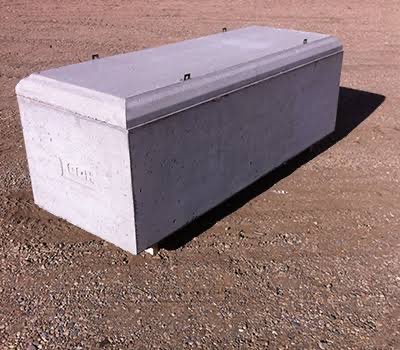
Here's a niche that doesn't get much attention in the wire industry, but it's one of the most demanding applications for steel wire:burial vault manufacturing.Every year, over 1.5 million burial vaults are produced in the United States. Each one requires precision-cut reinforcement wire - and the stakes are exactly what you'd imagine. A vault that fails underground isn't just a warranty claim. It's a family's worst nightmare and a manufacturer's existential crisis.
This is one application where quality isn't optional. The wire that goes into a burial vault isn't exposed to the elements like a fence or scaffolding tie. It's sealed inside concrete, underground, for decades. Every spec matters.
Why Wire Quality Matters in Vault Construction
Burial vaults are made by wrapping reinforcing wire around a concrete shell and then pouring more concrete over the top. The wire is the skeleton. It prevents concrete from cracking under load - because burial vaults carry enormous weight. Soil compaction, water pressure, equipment vibration during installation - it all pushes down on that wire. If the wire fails, the vault fails. And you can't fix it without exhuming it.
Most vault manufacturers use automated wire bending equipment that feeds wire through a series of mandrels and dies. The equipment is fast - it can produce finished wire forms in seconds. But it's also intolerant. Wire that's too soft bends inconsistently. Wire with lumps or bends causes jams. Wire with loose tolerances wastes material or doesn't fit the mold. Wire with the wrong finish corrodes before it's even installed.
This is where most wire distributors fail. They source from bulk commodity mills and cut it to length. No attention to straightness. No attention to tolerance stack-up. No attention to the hardness profile needed for automated equipment. The result: downtime, scrap, frustrated engineers, and missed deadlines.
Wire Types for Burial Vaults: Material, Gauge, and Finish
The vault industry uses five main wire profiles. Here's what each one does:
| Wire Type | Gauge Range | Typical Finish | Tensile (ksi) | Application |
|---|---|---|---|---|
| Bright Basic | 6-10 GA | Bare/Bright | 60-80 | Interior reinforcement, dry environments |
| Black Annealed | 6-10 GA | Black Oxide | 50-70 | Primary wrapping wire, cost-effective |
| Galvanized | 6-10 GA | Class C/A Zinc | 60-85 | Buried vaults, high-moisture regions |
| Oil Tempered | 5-8 GA | Light Oil/Bare | 80-120 | Heavy-duty structural reinforcement |
| Stainless (304) | 6-10 GA | Passivated | 85-110 | Premium vaults, indefinite lifespan |
Most vault manufacturers use a combination: black annealed for the primary wrapping layer (cheapest, adequate strength) and galvanized for the outer reinforcement (durability insurance). High-end vaults use oil tempered for maximum structural performance, or stainless steel for graves that will remain undisturbed for a century.
Understanding Vault Construction and Wire Placement
A burial vault consists of three main structural elements: an outer concrete shell, an inner concrete shell, and the reinforcement wire that binds them together. The process starts with a mold - typically made of fiberglass or steel. Wire is wrapped around the mold in a spiral pattern, creating a cage structure. Then concrete is poured into the cavity, filling the space between the wire and the inner shell.
The wire does two critical jobs. First, it provides tensile strength. Concrete is strong in compression but weak in tension. When soil shifts, or water pressure builds, the vault experiences tension forces. That's where the wire takes over. Second, the wire prevents concrete from cracking and spalling. Even small cracks allow moisture to penetrate and reach the casket. Microcracking - which develops over decades - can compromise the vault's integrity if there's no wire to hold the concrete together.
For this reason, vault manufacturers don't just use any wire. They use wire with specific tensile characteristics, specific surface finishes, and specific straightness profiles. Every vault form produced today has been engineered to work with a particular wire specification. If you hand the operator wire that doesn't meet spec, the equipment protests immediately. Jams, misfires, and bent wire forms cascade through production.
Custom Cutting and Straightening for Automated Vault Production
Most vault manufacturers don't buy wire in coils and straighten it themselves. They buy pre-cut, pre-straightened wire lengths that feed directly into their bending equipment. That's a game-changer for production efficiency. Instead of uncoiling, straightening, measuring, and cutting (four separate steps), you load a spool and go.
The challenge is precision. A 48-inch piece of 8-gauge wire for a vault form has to be straight to ±0.010 inches. Not close. Not "pretty much straight." Exactly straight. Automated equipment doesn't care about your story. If the wire is bent, the equipment jams. This is why sourcing matters so much. A wire distributor who can't deliver consistent straightness is costing you money every single day.
Western Steel & Wire supplies custom-cut and straightened wire in lengths from 2 inches to 40 feet, in gauges from 0.023" to 0.500" OD. We hold tolerances on both length (±0.032") and straightness (±0.004" for wire under 0.125"). For vault applications, this means your equipment doesn't jam. Your setup time drops. Your scrap rate stays near zero. We pack wire in spools or in bundled sets, depending on your production line setup. Most vault manufacturers we work with load a spool Monday morning and don't touch it again until Friday afternoon.
The Hidden Cost of "Good Enough" Wire
A vault manufacturer in the Midwest was sourcing wire from a general steel distributor. The wire was galvanized, the gauge was right, and the price was the lowest they'd ever seen. What they didn't see was the tolerance stack-up. The distributor was buying bulk coil stock from a mid-tier mill, straightening it with a basic straightener (not a precision machine), and cutting to length on a manual saw. Good enough for fence wire. Not good enough for vault production.
Their automated bending equipment was experiencing jams every 200-300 pieces. Not every day - every hour. Each jam meant stopping the line, removing the wire, troubleshooting, and restarting. Downtime was costing $340 per hour in labor and overhead. Three jams per shift. That's five hours of lost production time every week.
They also couldn't track the scrap rate accurately, but they suspected it was high. Each bend that didn't meet spec - angle off, length wrong, finish damaged - went into the reject bin. They estimated they were losing 2.8% to 3.2% of production to scrap, but nobody was measuring it carefully because the operation was chaos.
They switched to Western Steel & Wire's precision-cut wire. Tolerances tightened from ±0.008" to ±0.002" on diameter and ±0.004" on straightness. Jams dropped from every 200-300 pieces to one every 3,000 pieces - a 96% reduction. The scrap rate dropped from an estimated 3.2% to 0.4%. Within the first three months, the payoff was obvious. Annual savings: $52,000 in reduced downtime plus $18,000 in reduced material waste. Total: $70,000 per year.
"We didn't realize how much bad wire was costing us until we got good wire," the vault manufacturer told us. "Fixing the jam problem was just the beginning. Once we had consistent material, we could actually optimize our bending parameters. That meant faster production and better quality at the same time. We went from 32 vault forms per hour to 38 per hour. And our rework rate went to nearly zero."
Quality Specifications and Testing Requirements
The funeral vault industry doesn't have a single unified standard like ASTM or ISO. But vault manufacturers follow consensus specifications based on industry best practices and decades of operational learning. Here are the key specifications:
- Tensile Strength: Wire must meet ASTM A227 (for black annealed) or A228 (for oil tempered). Burial vault wire is almost never annealed wire; it needs strength to carry the dead load of soil and the dynamic loads of equipment and settling.
- Straightness: Wire diameter variation should not exceed 0.001 inches over any 12-inch section. That's tight, but automated equipment demands it. Any straightness deviation beyond ±0.010 inches will cause feeding issues.
- Surface Finish: For galvanized wire, the coating must be continuous and uniform - no bare spots, drips, or rough patches. Class C zinc (600-800 hours salt spray) is standard; Class A (1000+ hours) for premium vaults in high-moisture regions or those expected to last more than 50 years.
- Hardness Profile: Black annealed and galvanized wire need enough hardness to bend consistently without fracturing, but not so much that they snap in the bending die. Rockwell B 75-90 is typical. Oil tempered wire runs B 90-105.
- Dimensional Accuracy: Length tolerance of ±1/32 inch and diameter tolerance of ±0.002 inches. This allows vault manufacturers to nest forms precisely without manual adjustment. Looser tolerances force operators to hand-adjust every coil, killing throughput.
- Cleanliness: No mill scale, dirt, or debris. Wire passes through a visual inspection station before shipping. Any contamination risks jamming the bending equipment.
These specs aren't arbitrary. Each one solves a real problem discovered through years of manufacturing experience. A vault manufacturer who skips them saves a few cents per piece on wire and loses thousands in downtime and rework. The industry consensus is clear: tight specs pay for themselves.
Frequently Asked Questions
What type of wire is used in burial vaults?
Most burial vaults use either black annealed wire or galvanized steel wire, in gauges ranging from 6 GA to 10 GA (approximately 0.162" to 0.128" diameter). Black annealed is more cost-effective and is used for internal reinforcement. Galvanized is used for outer layers and in high-moisture regions because the zinc coating prevents rust. Some high-end vaults use oil tempered or stainless steel for greater longevity and structural performance.
What gauge wire do vault manufacturers use?
Most vault reinforcement wire is 8 GA or 9 GA. Heavier duty vaults use 6 GA or 7 GA, which provide greater tensile strength and are less prone to bending during installation. The choice depends on the soil type, water table, and expected load conditions at the burial site. Coastal regions and high-water-table areas almost always specify 6 GA or 7 GA because of the additional stress from moisture and soil movement.
Does burial vault wire need to be galvanized?
Not always, but it's strongly recommended. Black annealed wire is sealed inside concrete, which does provide some corrosion protection. However, concrete is porous, and water eventually penetrates it. In regions with high water tables, acidic soil, or coastal environments, galvanized wire is essential. For vaults expected to last 100+ years, galvanized or stainless is the only rational choice. A corrosion failure inside a vault is catastrophic and irreversible.
What straightness tolerance is required for vault wire?
For automated bending equipment, straightness should not exceed ±0.010 inches for wire 48 inches or shorter. Longer lengths (up to 40 feet) typically allow ±0.015 inches. Any straightness deviation beyond this will cause equipment jams and inconsistent bends. Vault manufacturers who don't specify this often don't know they have a problem until they see the downtime. A simple straightness specification can eliminate 70-90% of feeding issues.
Can wire be custom-cut and straightened for automated vault production?
Yes. Western Steel & Wire straightens and cuts wire to custom lengths with tight tolerances (±0.032" on length, ±0.004" on straightness). We produce wire in gauges from 0.023" to 0.500" OD, in lengths from 2 inches to 40 feet. This eliminates the vault manufacturer's need to invest in their own straightening equipment and allows them to purchase finished material that's ready to feed into their automated bending lines. We work with your equipment specs to ensure perfect compatibility.
The Bottom Line
Burial vault manufacturing is a niche industry, but it's one of the most unforgiving applications for steel wire. A vault that fails in service doesn't just cost the manufacturer a replacement. It costs them their reputation, their customer's trust, and their ability to do business. The wire that goes into those vaults has to be perfect.
That's why the vault manufacturers who win are the ones who obsess over their materials. They specify wire with tight tolerances. They verify straightness on every spool. They understand that the $0.02 they pay extra per piece in wire cost pays for itself ten times over in reduced downtime and zero scrap. They partner with suppliers who understand their business, not just vendors who sell commodity wire.
We understand vault manufacturing - and we understand the wire that makes it work. Western Steel & Wire has supplied precision-cut, tight-tolerance wire to vault manufacturers for decades. We know the specs. We know the equipment constraints. We know what downtime costs. We know what families expect from a burial vault, and we know the wire specifications that deliver on that promise. Visit westernsteelwire.com or call us to talk about your wire specifications. We'll get your production line running clean.

Comments (0)
Leave a Comment